Use these 8 checks to verify a Canada job offer before it costs you money. Each check is based on official Government of Canada sources.
A job offer from Canada can change your life. However, fake offers are common, and many of them look very real. That is why this guide explains how to verify a Canada job offer and its LMIA using official Government of Canada sources, so you can protect your money, your documents and your future applications.
Everything below is general information. In other words, it is not legal advice, and this website is not connected to the Government of Canada. So, for decisions about your own case, use the official sources linked on this page or a licensed representative.
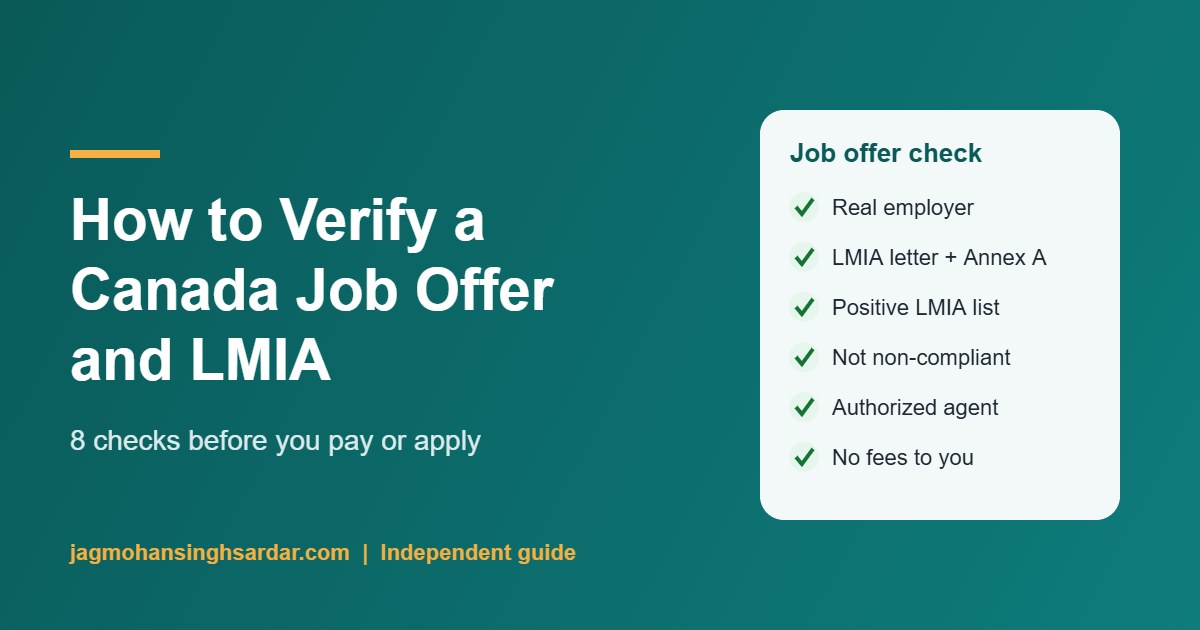
Quick answer: 8 steps to verify a Canada job offer
- First, confirm the employer is a real business, using contact details you find yourself.
- Next, ask which work permit route the job uses: an LMIA, or an LMIA-exempt offer.
- Then, for an LMIA job, ask for the LMIA confirmation letter and Annex A.
- After that, search the Government of Canada list of employers with positive LMIAs.
- Also, check that the employer is not on IRCC’s non-compliant employers list.
- In addition, check that any paid agent is an authorized representative.
- Above all, refuse any request to pay for the job, the LMIA or “visa guarantees”.
- Finally, apply for your work permit only through official IRCC channels.
What a genuine Canada job offer usually includes
Most foreign workers need a work permit, and most employer-specific work permits are based on one of two routes. With the first route, the employer gets a positive Labour Market Impact Assessment (LMIA) from Employment and Social Development Canada (ESDC). Alternatively, the job is exempt from the LMIA, and the employer submits the offer through IRCC’s Employer Portal instead.
| Document | Who provides it | What to check |
|---|---|---|
| Written job offer or employment contract | The employer | Job title, duties, wage, hours, work location, and signatures from both sides. |
| Positive LMIA confirmation letter and Annex A | ESDC sends it to the employer, and the employer shares a copy with the worker | The employer name, job title and location match your contract. |
| Offer of employment number (LMIA-exempt jobs) | The employer, after submitting the offer in IRCC’s Employer Portal | Ask the employer which LMIA exemption applies and why. |
| Work permit | Only IRCC (Immigration, Refugees and Citizenship Canada) | You apply yourself, or through an authorized representative. No employer or agent can issue it. |
In fact, ESDC’s instructions to employers say that after a positive LMIA, the employer should send the worker a copy of the LMIA letter and Annex A. The worker then includes these, together with the signed job offer, in the work permit application.
How to verify a Canada job offer: step by step
1. Confirm the Canada job offer comes from a real business
First, search for the company name yourself. For instance, look for a working website, a real street address in Canada, and reviews or news that go back several years. Then call the company’s main phone number from its own website, not the number in the offer. After that, ask the HR department whether the job and the hiring manager really exist.
Also, compare the email address in the offer with the company’s website domain. For example, a large company that hires through a free Gmail or Yahoo address is a warning sign.
2. Ask which work permit route the Canada job offer uses
Next, ask the employer directly: “Is this job based on an LMIA, or is it LMIA-exempt?” Above all, a real employer should answer this clearly. If they say “no paperwork is needed” or “we will arrange the visa for you”, be careful, because only IRCC can issue a work permit.
3. Check the LMIA letter
For an LMIA-based job, ask the employer for the LMIA confirmation letter and Annex A. Then check that the employer name, job title, wage and work location match your contract. Keep in mind that there is no public online tool where workers can type in an LMIA number and see the result. Therefore, the employer is your main official contact, and a real employer should be able to explain the LMIA to you.
4. Search the positive LMIA employers list
The Government of Canada publishes a list of employers who received a positive LMIA. Also, it is updated quarterly, and you can search it by employer, location and occupation. However, the list is not complete, so a missing name does not prove a scam. On the other hand, a name on the list does not prove that the offer you received came from that employer.
5. Check the non-compliant employers list
Similarly, IRCC publishes a list of employers found non-compliant with the temporary worker programs. Some of these employers are banned from hiring foreign workers for a period of time. As a result, an offer from a listed employer deserves extra caution.
6. Check the agent or representative
If someone charges you for immigration advice, IRCC says they must be authorized. In particular, paid representatives must be licensed immigration consultants with the College of Immigration and Citizenship Consultants, or lawyers and notaries in a Canadian law society or the Chambre des notaires du Québec. Then, you can check names on IRCC’s authorized representatives page.
7. Never pay for a Canada job offer or LMIA
For low-wage positions, ESDC says the $1,000 LMIA processing fee is paid by the employer and “can’t be paid by nor be recovered from temporary foreign workers”. In addition, employers must make sure that nobody recruiting for them charges workers recruitment fees. So if anyone asks you to pay for the job offer or the LMIA, treat it as a serious red flag.
8. Apply only through official channels
Finally, once you verify a Canada job offer, apply for the work permit through IRCC’s official website. IRCC says government fees are paid to the “Receiver General for Canada”, and its staff will never ask you to deposit money into a personal bank account. You can compare current government fees with our guide on the Canada work visa application fee.
Red flags of a fake Canada job offer
You must pay for the job
Fees for the job, the LMIA or “processing” paid to an agent or employer.
A “guaranteed” visa
In fact, IRCC says no one can guarantee you a job or a visa to Canada.
No interview
For example, you got the offer without any interview or skills check.
Free email address
The “company” uses Gmail, Yahoo or Hotmail, or only WhatsApp.
Salary too good to be true
Very high pay for a basic job, with free housing and flights.
Pressure and secrecy
“Pay today or lose the job”, or “do not tell anyone”.
Money to a personal account
Payment to an individual, a money transfer service, gift cards or crypto.
Details do not match
For instance, names, addresses or job titles change between documents.
Real vs fake job offer: a quick comparison
| Topic | Usually genuine | Usually fake |
|---|---|---|
| Fees | The employer pays the LMIA fee | You are asked to pay for the job or LMIA |
| Contact | Company email domain and a real Canadian address | Free email, WhatsApp only, no address |
| Selection | Interview, CV review, skills or language check | Instant offer with no interview |
| Visa | You apply to IRCC for the work permit | “We will send your visa” or “100% approval” |
| Documents | Consistent names, wage and location | Spelling errors, mismatched details, poor copies |
| Timeline | Realistic steps and processing times | Extreme urgency and pressure to pay |
Document checklist before you apply for a work permit
- A written job offer or contract, signed by you and the employer
- The positive LMIA letter and Annex A, or the employer’s offer of employment number for LMIA-exempt jobs
- Your valid passport
- Proof of your education, training and work experience for the job
- Language test results, if the job or program requires them
- Your own notes: who you spoke to, dates, and how you checked the employer
Tip: the exact documents depend on your country and the type of work permit. Always use the current document checklist on IRCC’s website for your application. Our guide to applying for a Canada work visa online explains the general process.
A practical example
Example (fictional): Ravi, a cook in India, gets a WhatsApp message offering a “Canada restaurant job” with a high salary, free housing and a “guaranteed LMIA”. The agent asks him to pay a fee for “LMIA processing” within 48 hours.
First, Ravi searches the restaurant himself and finds that its website lists a different phone number. Then he calls that number, and the manager says they are not hiring foreign workers. In addition, the agent is not on the CICC register. As a result, Ravi does not pay, keeps the chat as evidence, and reports it to the Canadian Anti-Fraud Centre.
Your rights as a temporary foreign worker
Temporary foreign workers have the same workplace rights and protections as Canadians and permanent residents. For example, employers must not:
- charge you hiring-related or recruitment fees,
- keep your passport or work permit,
- threaten your immigration status, or
- pay you less, or give you different work, than the LMIA and your contract say.
If that happens, you can report abuse to the Government of Canada’s confidential tip line at 1-866-602-9448, or use the online reporting tool. Moreover, according to the Government of Canada, live agents speak more than 200 languages and are available Monday to Friday, 6:30 am to 8 pm Eastern time.
What to do if you already paid or sent documents
- First, stop all payments and do not send more documents.
- Then, save every message, receipt, email and phone number.
- Next, report the scam to the Canadian Anti-Fraud Centre.
- Also, tell your bank or money transfer service right away.
- Finally, if your passport or ID was shared, report it to the police in your country.
Important: never submit a document to IRCC if you are not sure it is genuine. IRCC says sending false documents can lead to a ban of at least 5 years, and you are responsible for your application “even if a representative completes it for you”.
Related guides on this website
- LMIA jobs in Canada 2027
- Urgent jobs in Canada for foreigners with visa sponsorship
- Food packing jobs in Canada with visa sponsorship
- Work visa for Canada for Indian applicants
- How to check a Maple Leaf job offer letter
Canada job offer verification FAQs
How long does it take to verify a Canada job offer?
Most of these checks take a few hours to a few days. For example, searching the employer and the official lists is quick, while waiting for an employer to reply can take longer. However, never let anyone rush you into paying while you check.
Can I check an LMIA number online?
No. There is no public tool where a worker can enter an LMIA number and see the result. Instead, ask the employer for the LMIA letter and Annex A, check that the details match your contract, and search the public list of employers with positive LMIAs.
Is it legal for an employer to ask me to pay for an LMIA?
For low-wage positions, ESDC says the LMIA fee cannot be paid by or recovered from the worker. Employers must also make sure that recruiters do not charge workers recruitment fees.
Can an agent guarantee my Canada work visa?
No. IRCC says no one can guarantee you a job or a visa to Canada. In fact, only immigration officers decide whether to issue a visa or work permit.
What is the difference between an LMIA and a work permit?
An LMIA is a decision ESDC gives to the employer about hiring a foreign worker. By contrast, a work permit is a separate document that IRCC may issue to you after you apply.
What if the employer is not on the positive LMIA list?
The list is not complete and is updated quarterly, so a missing name does not prove fraud. However, you should check the other steps carefully before you continue.
Who can I pay for immigration help?
Only authorized representatives, such as CICC-licensed consultants and members of a Canadian law society, can charge you for immigration advice. You can check names on the official registers linked in check 6 above.
Not sure how to verify your Canada job offer?
Send us your questions through the WhatsApp button on this page. In short, we can explain the general steps on this checklist and point you to the official sources. However, we cannot confirm that a specific offer is genuine, we do not sell jobs, and we are not a licensed immigration consultant or law firm.
Official sources
- IRCC: Online and telephone scams
- ESDC: Program requirements for low-wage positions
- ESDC: Employer next steps after a positive LMIA
- Open Government: Positive LMIA employers list
- IRCC: Employers found non-compliant
- IRCC: Authorized representatives
- ESDC: Report abuse of temporary foreign workers
- IRCC: Consequences of fraud
- Canadian Anti-Fraud Centre: Report fraud